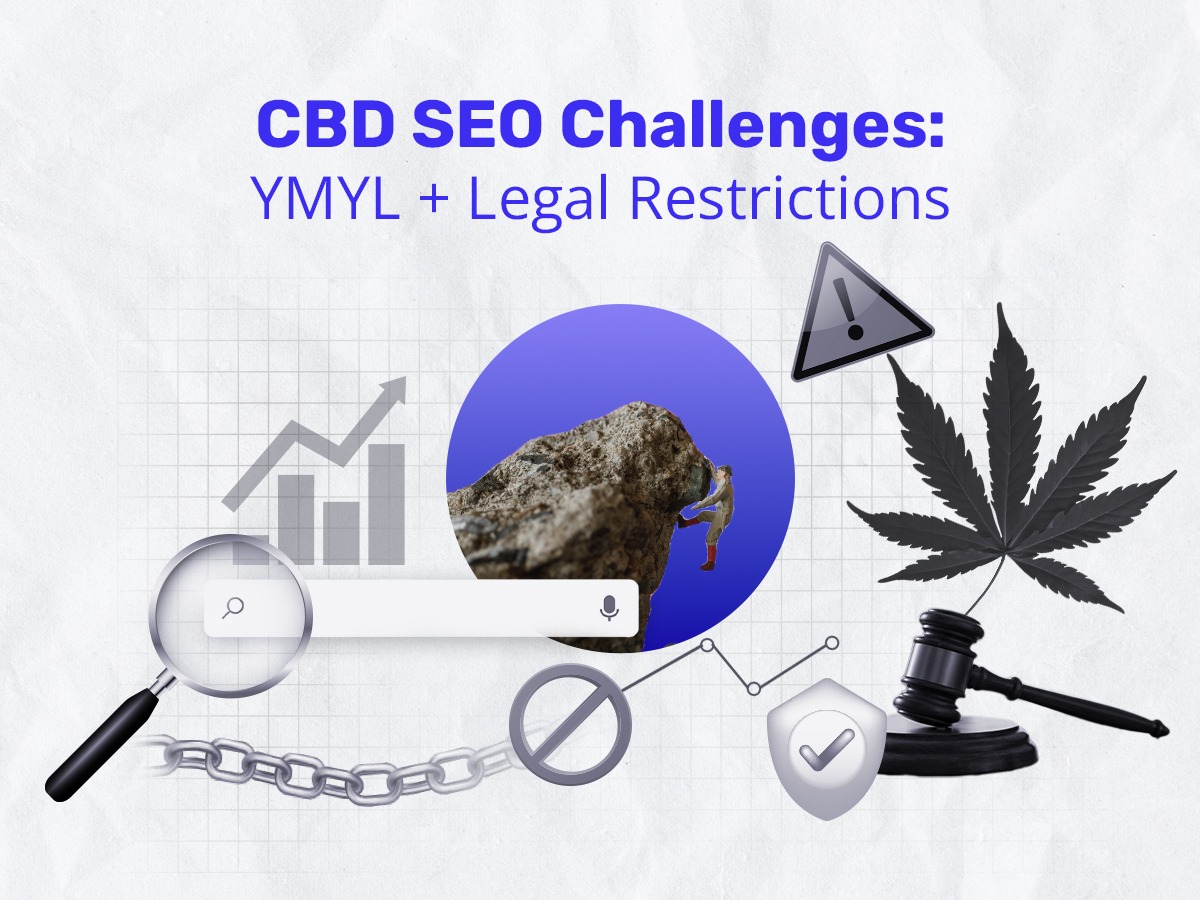
CBD SEO Challenges: YMYL + Legal Restrictions
CBD businesses are booming, but ranking on Google is far from easy. Most brands struggle because CBD is treated as a sensitive topic that directly affects people’s health, safety, and legal compliance. Add strict advertising bans, varying laws across states and countries, and Google’s YMYL standards, and you quickly realize why many CBD websites fail to get traffic.
The good news is that these challenges can be overcome. By understanding Google’s rules, following legal requirements, and creating content that builds trust and authority, your CBD(Cannabidiol) brand can not only rank higher but also earn credibility with your audience.
In this guide, we’ll break down the unique challenges of CBD SEO and show actionable strategies to grow your organic traffic safely and effectively.
Why CBD SEO is Hard: YMYL Rules & Legal Challenges
CBD SEO is harder than normal SEO because CBD sits in a sensitive and highly regulated space. Google treats CBD like a “serious topic,” and governments treat it like a “controlled product.”
This creates a double challenge:
- Google demands more trust, facts, and authority (YMYL).
- The law demands more rules, disclaimers, and safe wording.
Because of these challenges, many CBD brands turn to cannabis CBD link building services to safely improve their website authority and search rankings. This helps them build credibility with both search engines and potential customers.
1. Google’s YMYL Classification and What It Means
Google places CBD(Cannabidiol) content under YMYL: Your Money or Your Life.
This means Google believes CBD information can affect:
- someone’s health
- someone’s happiness or safety
- someone’s finances
Because of this, Google expects CBD websites to be extra trustworthy.
To rank, brands must show:
1. Experience: Real-world knowledge of CBD, production, usage, safety, or testing.
2. Expertise: Content written or reviewed by someone with real qualifications.
Example: chemists, medical advisors, lab experts, or people with industry certifications.
3. Authoritativeness: Mentions on reputable websites, real reviews, media features, and strong backlinks.
4. Trustworthiness: Clear product info, COAs (lab reports), no fake claims, and honest education-first content.
If you fail any of these, Google becomes strict and your site won’t rank well.
That’s why CBD Content Quality Framework should be examined properly.
2. How Legal Restrictions Shape CBD SEO Strategy?
CBD laws change from place to place, country to country, state to state, and sometimes even city to city.
This creates major challenges:
- You must avoid medical claims (“cures,” “treats,” “heals,” etc.).
- You must include disclaimers and age restrictions (18+ or 21+ depending on location).
- You must stay updated as laws change often.
- You must make sure your content doesn’t promise things CBD legally cannot guarantee.
Because of this, Cannabidiol SEO becomes a compliance-first strategy.
You have to write content that is:
- helpful
- accurate
- well-researched
- legally safe
Even if you know your product helps people, you cannot say it directly.
Instead, you must focus on education, not claims.
Example:
“CBD cures anxiety.”
“Some studies suggest CBD may help with stress, but more research is needed.”
This safe approach protects you from legal risk while keeping Google happy.
3. Why Advertising Limitations Make SEO the Primary Channel?
CBD brands cannot rely on paid ads like most industries.
Platforms like:
- Google Ads
- Facebook & Instagram
- TikTok
all have heavy restrictions or near-total bans on CBD advertising.
This means:
SEO becomes the main growth engine.
You can’t simply “boost” posts or run standard ads.
So your organic strategy must be strong enough to:
- attract traffic
- build trust
- capture customers
- grow without paid ads
Because ads are limited, CBD brands must focus on:
- long-tail keywords
- educational content
- local SEO
- trust-building
- authority-building
- transparent product information
YMYL Challenges: How CBD Sites Must Prove Trust & Authority?
CBD brands face an extra-tough version of SEO because Google treats CBD as a high-risk topic. Anything related to health, safety, or money falls under Google’s YMYL (Your Money or Your Life).
This means Google wants proof, not guesses… facts, not opinions… and verified experts, not random writers.
To rank in this space, a CBD brand must show it is credible, careful, and transparent in every piece of content.
1. Elevated E-E-A-T Requirements for Cannabidiol Content
For CBD content, Google raises the bar for E-E-A-T (Experience, Expertise, Authoritativeness, Trustworthiness).
It’s stricter because CBD affects health choices, and wrong information can harm people.
CBD sites need to show:
- Experience: real-world knowledge of CBD production, testing, usage, or industry work.
- Expertise: content guided or reviewed by someone with scientific or medical understanding.
- Authority: mentions on trusted sites, strong backlinks, consistent brand signals.
- Trust: honest explanations, safe wording, clear product info, proof of testing.
If a CBD website doesn’t show strong E-E-A-T, Google treats it as risky and it won’t rank well.
2. Content Accuracy + Scientific Backing
Cannabidiol brands cannot publish “opinions” or “claims without proof.”
Every health-related detail must be:
- accurate
- backed by real studies
- based on verified scientific sources
- updated when new research appears
Google checks for:
- outdated information
- misleading statements
- exaggerated benefits
- missing references
- vague explanations
CBD content needs to be written like educational material, not sales copy.
Simple, factual, science-backed writing is what Google trusts most.
3. Restrictions on Health Claims
This is one of the biggest challenges.
CBD brands are not allowed to say their products cure or treat medical conditions.
Laws in many countries require brands to avoid:
- medical promises
- disease claims
- guaranteed results
- phrases like “treats anxiety,” “heals pain,” “stops inflammation,” etc.
Even if customers say CBD helped them, brands cannot phrase it as a proven fact.
Safe content uses:
- soft, educational language
- descriptions of studies (not promises)
- balanced explanations (“may help,” “might support,” “research suggests”)
- disclaimers
Google rewards brands that stay safe and honest because this builds long-term trust.
4. Author Credentials and Trust Visibility
In YMYL niches, Google wants to know exactly who is giving the advice.
CBD websites must clearly show:
- who wrote the article
- their qualifications
- why they are trusted
- links to professional profiles
- if a medical or scientific reviewer checked the content
This is how a CBD page proves reliability.
“Anonymous content” or articles written by random freelancers weaken trust and hurt rankings.
CBD sites that highlight real experts like lab technicians, chemists, medical advisors, or experienced industry professionals rank better.
5. Backlink Limitations in a Restricted Industry
Even if a Cannabidiol brand writes great content, building backlinks is harder because:
- many websites avoid linking to CBD pages
- some publications have strict “no CBD/cannabis” policies
- advertising networks ban CBD, limiting exposure
- health sites require heavy proof before linking
This makes normal SEO tactics less effective.
To earn quality backlinks, CBD brands must focus on:
- educational guides
- legal updates
- industry reports
- lab testing and transparency
- expert-led content
- community involvement
- local partnerships
Because CBD are restricted niches, CBD SEO grows slower than typical niches, but high-authority backlinks are still the biggest ranking factor.
CBD Legal Barriers: Laws, Disclaimers & Compliance Rules
CBD SEO doesn’t just compete with Google’s algorithms, it also competes with laws. If your website breaks rules, even unintentionally, you can lose rankings or face legal trouble. Understanding how laws work is the first step to a safe and effective strategy.
1. Patchwork Legality Across States and Countries
CBD isn’t the same everywhere. Some places allow it fully, some allow only hemp-derived CBD, and others ban it completely. Even within a single country, rules can change by state, province, or city.
Your content must reflect the laws where your audience lives. A product legal in one state could be illegal in another, and Google may flag your site if you make misleading claims.
Actionable tip:
- Maintain a “CBD legality by region” page or map.
- Update it frequently to reflect new legislation.
- Use geo-targeting for content to avoid showing illegal products to certain locations.
2. Required Disclaimers and Age Restrictions
Almost every region that allows CBD requires:
- Age verification (18+, 21+ depending on local law)
- Disclaimers about health claims
- Warnings for sensitive populations
Failing to include disclaimers or age restrictions can trigger both legal trouble and Google penalties.
Actionable tip:
- Always include a short disclaimer at the top of your product or content pages.
- Add pop-ups or age verification for stores selling online.
- Reference legal sources or studies where applicable to show transparency.
3. Compliance-First Content Rules
Content must focus on education, not sales hype. That means:
- No medical promises
- No “miracle cure” language
- Accurate descriptions backed by studies
Google favors content that’s accurate and helpful. Misleading content can hurt rankings under YMYL rules.
Actionable tip:
- Use neutral, factual language (“may support,” “research suggests”).
- Cite reliable sources.
- Include legal disclaimers prominently.
4. Why Laws Change Frequently and Must Be Updated?
Cannabidiol (CBD) rules evolve quickly, and what’s legal today may not be tomorrow. Sites that ignore updates risk:
- Losing rankings
- Being removed from search results
- Legal action
Actionable tip:
- Schedule quarterly reviews of your CBD content.
- Update disclaimers, product info, and legality statements as needed.
- Track Google’s and FDA’s policy changes closely.
CBD SEO Strategies to Overcome YMYL and Legal Challenges
Even with strict YMYL and legal barriers, Cannabidiol (CBD) brands can succeed with smart, compliant SEO strategies.
1. Lead With Educational Search Intent
People search for answers, not ads. Content should focus on:
- How CBD works
- Safety information
- Scientific studies
- Legal guidelines
Google rewards content that educates, especially in YMYL niches.
Ationable tip:
- Write guides, FAQs, tutorials.
- Solve specific problems (e.g., “How to choose safe CBD oils”).
2. Long-Tail Keyword Strategy for Targeted Traffic
Short, broad keywords are very competitive, but long-tail queries are easier to rank for and more targeted.
Examples:
- “Best CBD oil for sleep in California”
- “CBD tinctures legal in New York”
- “How to read CBD lab reports”
Actionable tip:
- Research regional, intent-based queries.
- Create dedicated pages for high-value long-tail topics.
3. Building Trust Through Transparency (COAs, Testing, Sourcing)
Trust is everything in CBD. Google and users want proof you’re reliable.
Ways to build trust:
- Show Certificates of Analysis (COAs)
- Explain sourcing and testing methods
- Be upfront about ingredients and concentrations
Actionable tip:
- Add a “Lab Results” section per product.
- Link to third-party tests for verification.
- Include author bios and expert reviews.
4. Local SEO Optimization for Cannabidiol Stores
For physical dispensaries, local SEO is powerful. Many customers search “CBD near me” or “CBD dispensary in [city].”
Actionable tip:
- Optimize Google Business Profile
- Use local keywords in content and metadata
- Encourage verified local reviews
- Ensure NAP (Name, Address, Phone) consistency across platforms
5. Safe Link-Building Opportunities
Getting backlinks is harder for CBD, but it’s still possible:
- Collaborate with educational sites and news outlets
- Guest post on industry blogs
- Share research-backed guides
- Partner with local businesses or associations
Actionable tip:
- Focus on high-authority, reputable sites that allow CBD references.
- Avoid spammy directories, they can harm trust.
6. Structuring Content Hub Around Legal, Safety, and Research Topics
A content hub helps Google see your website as an authority cluster.
Example structure:
- Main hub page: “CBD Safety and Legal Guide”
- Sub-pages:
- “CBD Lab Testing Explained”
- “CBD Laws by State”
- “How to Read CBD Product Labels”
- “Scientific Research on CBD Benefits”
Actionable tip:
- Link all sub-pages back to the hub and to each other.
- Keep the hub updated regularly to maintain authority.
How to Avoid CBD SEO Penalties and Stay Compliant?
CBD brands must be extremely careful because even small mistakes can trigger Google penalties or legal issues to your website and mobile application. One of the most common pitfalls is making claims that the products cannot legally support.
You should never say your CBD products cure, treat, or heal diseases, guarantee results, replace medical treatment, or provide “miracle” benefits. Instead, focus on educational and factual language, using phrasing like “may help,” “research suggests,” or “studies show potential.”
Following these rules keeps your content legally safe and trustworthy, while also satisfying Google’s YMYL standards.
How to Write CBD Content Without Triggering YMYL Red Flags?
Write content in a neutral and factual tone. Always cite credible sources and studies, show clear author credentials, include disclaimers and age restrictions, and focus on education rather than marketing hype. Review each page with a compliance checklist and have an industry expert double-check sensitive content.
Compliance Checklist for Every Page
Keep the checklist as a standard operating procedure for all new content.
Every CBD page should include:
- Correct age restrictions and disclaimers
- Verified facts and research citations
- Clear author credentials
- Neutral language avoiding unverified health claims
- Regional legality notice (state/country-specific)
- Optional: links to COAs, lab results, or regulatory references
Conclusion
CBD (Cannabidiol) SEO is a delicate balance between compliance, trust, and visibility. It’s not just about using the right keywords, it’s about showing expertise, providing accurate information, staying legally compliant, and building authority over time.
While the rules are strict and the path may seem challenging, a careful, education-first SEO strategy allows your brand to stand out, attract the right audience, and grow sustainably.
By following the strategies outlined in this guide, Cannabidiol businesses can turn regulatory challenges into opportunities for authority and long-term success.
Frequently Asked Questions
What does YMYL mean in CBD SEO?
YMYL stands for “Your Money or Your Life.” Google treats CBD (Cannabidiol) content as YMYL because it can affect a person’s health and safety. This means websites must provide accurate, trustworthy, and expert-backed information to rank well.
Why is CBD SEO more challenging than other industries?
CBD SEO is tougher because the content falls under YMYL, advertising platforms limit paid promotions, laws differ from state to state and country to country, and building authoritative backlinks is more difficult. Success relies on creating content that is both safe and reliable.
Can CBD brands use Google Ads or other paid advertising?
Most major advertising platforms, including Google Ads and Facebook, restrict or ban CBD promotions. This makes organic SEO the main channel for reaching potential customers and driving traffic to the website.
How can CBD brands ensure their content is compliant and safe?
Content must focus on education rather than making medical claims. It should present factual information supported by research, written in neutral language, and include clear disclaimers and any applicable age or regional restrictions.
What is E-E-A-T and why is it important for CBD websites?
E-E-A-T stands for Experience, Expertise, Authoritativeness, and Trustworthiness. CBD websites must show real-world experience, have content reviewed or written by qualified professionals, build authority through reputable mentions and backlinks, and maintain transparency with accurate product information and certifications.
How can CBD brands keep up with changing laws and regulations?
CBD laws change frequently, so websites need to regularly update content, disclaimers, and product information. Keeping track of local, state, and national regulations ensures that the brand remains compliant, builds trust with users, and maintains Google rankings.